
Please disclose if any significant portion of your mod was created using AI tools by adding the 'AI Generated' category. Failing to do so may result in the mod being removed from Thunderstore.

LivingFactions
NPC factions build settlements, trade, fell and replant forests, march war bands and lay siege. Envoys, boss hunts, relic axes, swords and shields, multiplayer. EN, RU, PL, DE, FR, ES, PT. Discord: discord.gg/qVfAq3fqj6
| Date uploaded | 2 weeks ago |
| Version | 0.8.1 |
| Download link | under2ker-LivingFactions-0.8.1.zip |
| Downloads | 803 |
| Dependency string | under2ker-LivingFactions-0.8.1 |
This mod requires the following mods to function

ValheimModding-Jotunn
Jötunn (/ˈjɔːtʊn/, 'giant'), the Valheim Library was created with the goal of making the lives of mod developers easier. It enables you to create mods for Valheim using an abstracted API so you can focus on the actual content creation.
Preferred version: 2.30.2
denikson-BepInExPack_Valheim
BepInEx pack for Valheim. Preconfigured with the correct entry point for mods and preferred defaults for the community.
Preferred version: 5.4.2351README
Living Factions
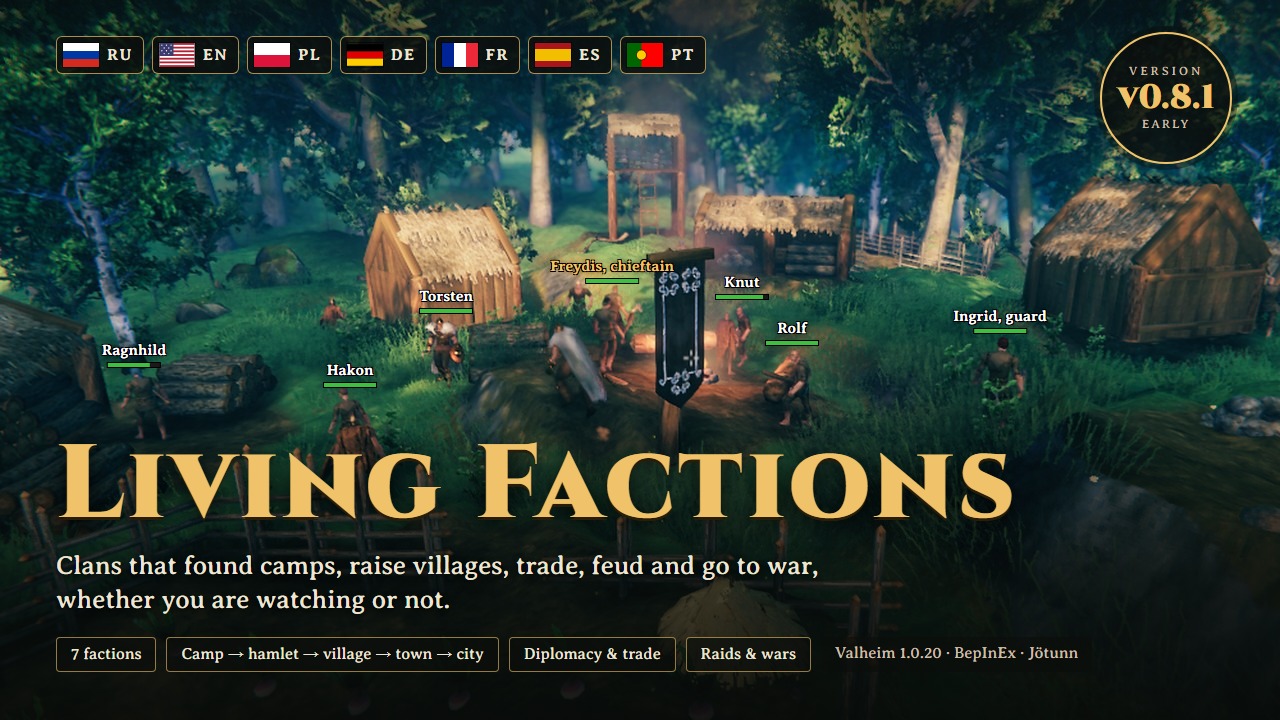
A Valheim mod that adds seven NPC factions to your world. They set up camps, gather wood, stone and food, put up buildings one piece at a time and grow into villages and towns. They trade with each other, fall out, go to war and take each other's settlements. All of this goes on whether you are around or not, and you can take part: trade, bring gifts, make friends, start a war.
Made for Valheim 1.0.20 with BepInEx 5 and Jötunn. It is an early version.
Playing together
Works since 0.4.0, on a dedicated server or with a player hosting.
- Everyone needs the mod: the server and every player. Somebody without it, or with another 0.x version of it (0.7 against 0.8), is not let in.
- On a dedicated server put BepInEx, Jötunn and
LivingFactions.dllinto the server folder the same way as into the game. The state of the factions is kept on the server, next to its config. - The host runs the factions. The player nearest a settlement is the one who builds it.
- Tested with a dedicated server and one guest over Steam. Crossplay servers and two players in the same village at once have not been tested yet, so tell us how it goes.
- Back up the server world before the first run.
Feedback, bug reports and chat: Discord.
Русское описание ниже.
The factions
| Faction | Who | Where | What they are like |
|---|---|---|---|
| Raven Clan | humans | Meadows, Black Forest | even-tempered, keep their word |
| Wolf Clan | humans | Black Forest, Meadows, Mountain | quick to fight |
| Stag Clan | humans | Meadows, Plains | traders, peaceful |
| Fuling Horde | Fulings | Plains | raiders |
| Dvergr Hold | Dvergr | Mistlands, Black Forest, Mountain | traders, proud |
| Greydwarf Brood | Greydwarfs | Black Forest | spread fast, do not trade |
| Draugr Court | Draugr | Swamp | hate the living |
Each one starts with a single camp. If there is no room for a faction at first, it shows up later. Settlements you have been to get a pin on the map.
What happens in the world
Settlements grow. Camp, hamlet, village, town, city. A settlement has stores of wood, stone, food, metal and coins, and its people are split between gathering, building and guard duty. It builds what it is short of: houses when it gets crowded, a storehouse when the stores are full, farms and workshops, then a watchtower, a smithy and a market, and later a palisade and a great hall. Only the capital of a faction becomes a city.
The buildings are real. They are made of the normal build pieces and go up in order, so a house that is half done is a floor and a few walls with no roof. While you are away the settlement keeps developing in the simulation and catches up when you come back.
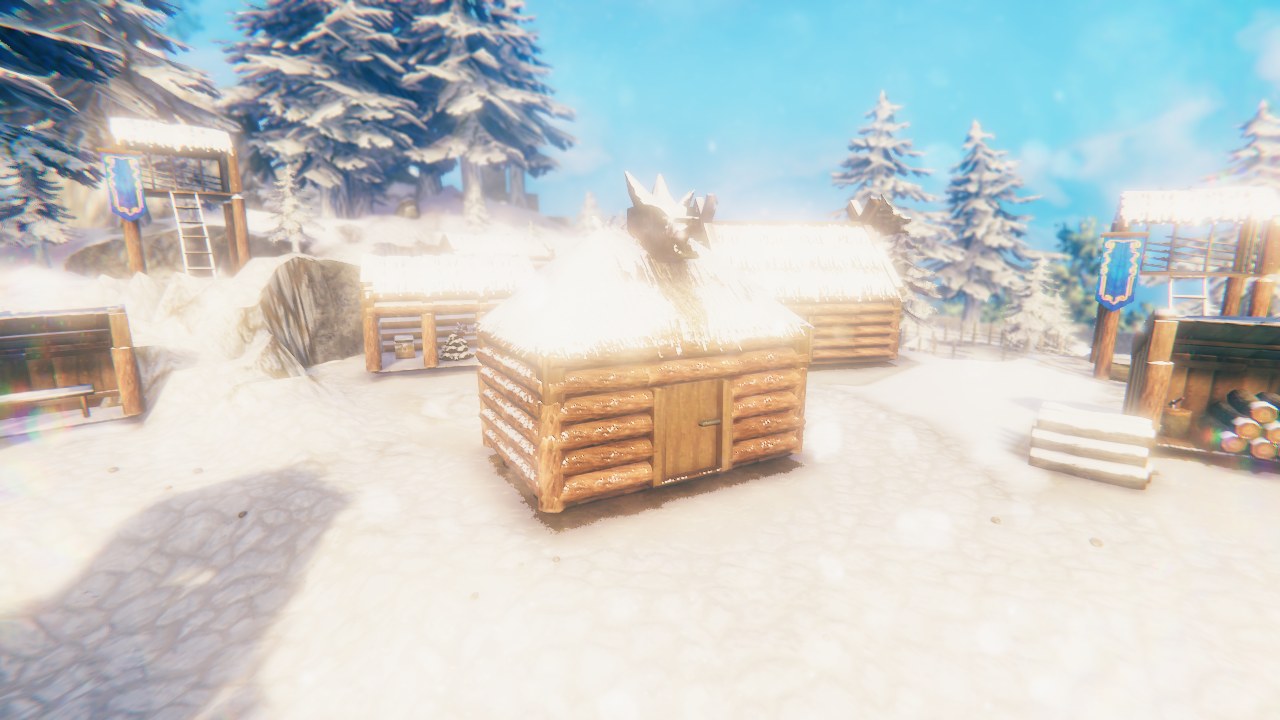
Every people builds its own way. The Raven Clan roofs everything in dark shingles on dark posts, with a raven carved on each end of a home's ridge. The Wolf Clan lays its walls log on log under hipped thatch, a carved wolf looking out over the door. The Stag Clan keeps the thatched gable and gives every door a porch. Fulings live in round huts under hide cones, Greydwarfs den among roots, the Draugr build in stone and the Dvergr roof in dark shingles.
People have a day. They walk to trees, rocks, fields and building sites, work there and carry their loads to the storehouse, where they put them into its chests: open one and the carrots, wood or meat are there. More of them take up the trade the settlement is short of. Between shifts they visit a neighbour or take a walk down the road. By day half the guards walk a round out along the road and back, one stands on the watchtower, some of them are archers. At night everyone sleeps in the beds of their own house, two to a bed.
A thief in the night. Open one of their chests after dark and a count starts: a few seconds if people sleep in that house, half a minute in an empty storehouse. Take something of theirs and stay too long, and the village wakes and the watch goes for you. What you put in a chest yourself is yours to take out again.
Bands on the move. A settlement short of wood, stone, food or metal sends a band of two to six out to where it is plentiful, up to 1.4 km away, weighing the distance against the danger of the way. A raid is a band too: it marches to its target, fights at the gate and carries its loot home. Near you the bands are people walking the land, and killing one costs the band a man.
War campaigns. A warlike faction at war sends scouts, sets up a war camp of tents, stakes and banners more than halfway to an enemy place, garrisons it, and marches on the target from there. Home sends soldiers and food along a supply line, allies of either side may join, and a place that falls may be taken back a day later. Arms cost metal, and a long campaign wears a faction out.
Outposts and moving house. A faction with people to spare puts a small camp where the land gives what home lacks (timber, stone, soil, ore), or a watch post halfway along a long road. People leave a place that starves, or a small one an enemy war camp has come close to.
Woodcutters and the forest. Woodcutters fell real trees, at least 10 m from the buildings and falling away from the village. The trunk is carried off and a sapling of the same kind goes into the stump's place, so a village in the woods ends up in a clearing of young trees, not a bare field.
Boss hunts. Ask a chief about a hunt and they name the next great beast they want dead, with a bounty in coins. Kill it, come back to any chief of that faction and collect. Every boss you kill is news: the clans like you better for it, while the Greydwarfs, the Draugr and the Fulings take the death of their own Elder, Bonemass and Yagluth badly.
Roads and caravans. Every settlement has a road to its nearest neighbour, up to 1500 m. The road takes gentle ways over dry land, its bed cut or built up where the land is steep, has a lamp post every 30 m outside the walls, and comes in by a street to the square through a gate in the wall. A town has a palisade, a city a stone wall with towers. A settlement on an island has no road. Traders with two guards come and go along it.
Politics. Relations change with shared borders, trade, incidents and common enemies. A war means raids: stores are looted, buildings burn, a settlement can change hands. If you are in a settlement when it is raided, the raiders really turn up.
What you can do
- Talk to anyone with
E. You see how the faction feels about you, what the settlement has and what it needs. The dialogue also explains the latest changes of your standing. - Give gifts. Things they are short of count double.
- Trade. Buy from their stores and sell your own goods. Prices depend on how scarce something is and how much they like you.
- Hire fighters for 120 coins plus 40 for each size step of the settlement: two for 10 minutes from anyone who will deal with you, four for 15 from friends, six for 24 from allies. They go through portals with you.
- Declare war, pay for peace, or make an alliance once your standing is 70 or more.
- Talk to the envoy. Every settlement has an envoy's tent by its road out, and the envoy talks to you whatever the faction thinks of you, even at war: takes gifts (tribute at war), hears a plea for peace and tells you plainly what stands between you. Near the tent nobody attacks you.
- A blow on one of their people costs standing, and they fight back only after a few, more of them the better they like you (five for an ally, one for a wary faction). Killing their people or breaking their buildings costs more, and enough of it means war. A killing nobody saw may come out days later. Killing monsters near their homes or raiders attacking them earns standing.
- Their fields, hives and buildings are theirs: their crops cannot be picked, their pieces cannot be taken down for the materials.
There are seven relic axes and seven swords, one of each for every faction:
| Axe | Faction | What it does | How you get it |
|---|---|---|---|
| Wolf's Fang | Wolf Clan | +25% damage | bought from the clan, standing 40 |
| Stag's Horn | Stag Clan | traders 10% cheaper, swings cost 20% less stamina | bought from the clan, standing 60 |
| Raven's Wing | Raven Clan | +25% damage | strike down two raiders attacking a Raven Clan place |
| Blackgnaw | Fuling Horde | +25% damage below a third of your health | taken from a Fuling chieftain |
| Rune Cleaver | Dvergr Hold | double durability | a thane's gift to an ally at standing 80 |
| Rootbiter | Greydwarf Brood | mends itself in the hand | carried by a Greydwarf chief |
| Barrow Moon | Draugr Court | 5% of the damage you deal heals you | carried by a Draugr chief |
To make an alliance, talk to anyone in the settlement: the window shows your standing and how far it is from the 70 an alliance needs, and each gift shows what it would earn. A gift of what they are short of counts double; many gifts in one day count for less.

| Sword | Faction | What it does | How you get it |
|---|---|---|---|
| Grey Blade | Wolf Clan | +25% damage | bought from the clan, standing 50 |
| Antlered Blade | Stag Clan | double durability | bought from the clan, standing 30 |
| Black Beak | Raven Clan | half the weight | bought from the clan, standing 40 |
| Obsidian Saber | Fuling Horde | +25% damage | bought from the horde, standing 20 |
| Rune Sword | Dvergr Hold | +25% damage | bought from the hold, standing 40 |
| Root Club | Greydwarf Brood | double durability | one Greydwarf guard in four leaves it |
| Rusted Blade | Draugr Court | double durability | bought from the court, standing 10 |

| Shield | Faction | What it does | How you get it |
|---|---|---|---|
| Wolf-Hide Shield | Wolf Clan | +20% armour and block | bought from the clan, standing 30 |
| Stag-Trail Shield | Stag Clan | +20% armour and block | bought from the clan, standing 30 |
| Raven Kite | Raven Clan | +20% armour and block | bought from the clan, standing 40 |
| Bone Shield | Fuling Horde | +20% armour and block | bought from the horde, standing 20 |
| Copper Shield | Dvergr Hold | +20% armour and block | bought from the hold, standing 40 |
| Bark Shield | Greydwarf Brood | +20% armour and block | left by their guards, after the root club |
| Bone-Plate Shield | Draugr Court | +20% armour and block | bought from the court, standing 10 |

From a village up, the clans' fighters carry their clan's shield, and the chief and one fighter in three its sword.
On screen
- A chronicle panel shows what the nearest settlement is doing and what the other factions are up to. Alt+H hides it or shows it again. To move or collapse it, open the inventory, click the LF icon and choose Customize chronicle under General. Drag the preview, choose Collapse or Expand, and click Save to keep the position and display mode.
- The large map shows the land of every settlement you know of in its faction's colour, with a legend of the factions. Each settlement is named with its size; zoom in or point at it to see the faction, how it stands with you, its people and warriors, what it is short of and its trouble (under attack, food running out, at war).
- The people of the factions near you are dots on the minimap in their faction's colour, red when they are hostile to you.
- Settings are behind the "LF" tile on the inventory screen (Tab).
- The mod speaks English, Russian, Polish, German, French, Spanish and Portuguese. It follows the language of the game, or you can pick one in the menu whatever the game is set to. In Russian the names of people and settlements are Russian too.
Screenshots


Install
With r2modman or Thunderstore Mod Manager: install the package. BepInEx and Jötunn come with it.
By hand:
- Install BepInExPack Valheim and Jötunn.
- Copy
LivingFactions.dllintoValheim/BepInEx/plugins/LivingFactions/. - Start a world. The factions arrive on the first day. An existing world works too.
Back up your world before the first run. Settlements level the ground and place pieces.
The state of the factions is saved in BepInEx/config/LivingFactions/<world>_<uid>.json every
time the world saves, with a dated copy of the last 60 saves beside it. If you restore a backup of
the world, the factions go back to the same point too (from 0.6.1 on). Buildings that are on record
but missing from the world are put up again. lf rewind takes the factions back without touching
the world, for example after an lf advance too far. A state file that cannot be read (cut short by
a crash, say) does not start the factions over: it is kept aside as .unreadable-<time> and the
factions are taken from the backup beside it (.bak) or from the latest dated copy. A state saved by
a newer version of the mod is not loaded by an older one; it is kept aside the same way.
Settings
Use the menu in the game or edit BepInEx/config/alexandr.livingfactions.cfg. You can change the
pace of the simulation, turn wars and the non-human factions on or off, limit how many villagers
are shown, switch roads, lamps, caravans, hired fighters, the minimap dots, the clearing of loose
items from settlements and the chronicle panel on or off, and pick the language (auto follows
the game, or one of en, ru, pl, de, fr, es, pt). Also: how fast standing fades
(World/ReputationDecay: 1 as made, 0 never), how many fighters you may hire and for how long
(World/HiredLimit, World/HireMinutes), how many blows each standing forgives and how far angry
people follow you (section Conflict), and the key for the chronicle (General/ChronicleKey).
Console
Start the game with -console and press F5.
| Command | What it does |
|---|---|
lf status |
lists factions and settlements with the distance to each |
lf factions |
your standing with each faction and who is at war |
lf chronicle [n] |
recent events |
lf advance <days> |
runs the simulation forward |
lf rewind [day] |
lists the days you can go back to, or takes the factions back (-30: thirty days back) |
lf tp <settlement> |
takes you to a settlement |
lf rep <faction#> <value> |
sets the host player's standing; unavailable to guests |
Known limits
- Playing together is new and lightly tested. Back up the server world before the first run.
- Woodcutters fell trees and carriers fill the chests, but what a settlement gathers is still counted by the simulation.
- Ground the mod levelled before 0.7.0 along the borders of terrain tiles while you worked it with the hoe may have ditches or humps: level them over once more.
- If you remove the mod, the buildings stay in the world as normal pieces.
Building from source
You need the .NET SDK and Valheim with BepInEx and Jötunn. Set VALHEIM_INSTALL if the game is
not in the default Steam folder.
dotnet build src/LivingFactions -c Release
dotnet run --project tools/SimHarness
The first command builds the plugin and copies it into the game. The second runs the simulation
without the game and checks it. src/LivingFactions.Core is the simulation and does not depend
on the game.
По-русски
Мод добавляет в мир семь фракций NPC: три клана людей, фулингов, двергов, грейдворфов и драугров. Они ставят лагеря, добывают ресурсы, строят дома по одной детали и вырастают в деревни и города. Между собой торгуют, ссорятся и воюют, даже когда вас нет рядом.
Дровосеки по-настоящему рубят деревья и сажают на их месте саженцы, носильщики кладут добытое в сундуки склада. Ночью жители спят в своих кроватях, а вора, открывшего их сундук, ловит стража. Поселения шлют отряды за ресурсами, воюющие фракции ставят военные лагеря и ведут осады. У каждого поселения есть шатёр посла: с ним можно говорить даже во время войны. Каждый клан строит по-своему: у Ворона тёмная черепица и резные вороны на коньках, у Волка бревенчатые стены и вальмовые крыши, у Оленя крыльцо у каждой двери. Вожди дают охоту на боссов за награду. У каждой фракции есть свой топор-реликвия, свой меч и свой щит. На большой карте земли фракций отмечены их цветом. С жителями можно говорить (E), торговать, дарить подарки, нанимать бойцов, заключать союз или
объявлять войну. Между поселениями есть дороги с фонарями, по ним ходят караваны. Настройки
открываются плиткой «LF» в инвентаре.
Установка: через r2modman или Thunderstore Mod Manager, либо положите LivingFactions.dll в
Valheim/BepInEx/plugins/LivingFactions/. Нужны BepInExPack Valheim и Jötunn. Перед первым
запуском сделайте копию мира.
С версии 0.4.0 можно играть вместе: на выделенном сервере или у игрока-хоста. Мод нужен всем, включая сервер. Проверено с сервером и одним гостем.
Если восстановить мир из бэкапа, фракции тоже вернутся к тому же моменту. Команда lf rewind
откатывает фракции назад, не трогая мир (например, после слишком большого lf advance). Если файл
состояния фракций не читается (например, оборвался при вылете игры), фракции не начинаются заново:
файл откладывается как .unreadable-<время>, а состояние берётся из резервной копии .bak или из
последней сохранённой копии. Файл от более новой версии мода старая версия не загружает.
Отзывы, баги и общение: Discord.
Credits
CHANGELOG
Changelog
0.8.1 - 2026-11-11
- The dialogue explains the latest changes of standing: gifts, trade, help, crimes, war and the slow fading of old deeds.
- Roads prepare loaded ground farther ahead, then pave it in batches once the bed is ready. Shared terrain edges are repaired as both tiles finish, and town streets avoid shortcuts through water or across steep banks.
- Settlement ground slopes into the building pads along streets and paths. The grading reaches the edge of the building footprint to smooth sharp spikes left by the levelling brush. Existing settlements are graded as they load.
- Roads are laid into the ground point by point instead of disc by disc: the way rises and falls evenly along its bed, with smooth banks beside it, instead of steps, ridges and sharp edges. Tiles of a road cut by an older version are laid again when visited.
- A road point whose paint could not be finished is painted again later instead of staying a gap; past a building the road narrows instead of breaking off.
- Ways between settlements are chosen by how steep their finished bed would be: a way round a hill, or up it in turns, is taken over one straight up its face.
- Hired fighters remember who hired them and follow only that player, including through portals.
- In the mod settings, drag the chronicle anywhere on screen and choose whether it shows all the news or just the heading and day. Save keeps both choices.
- New settlements and outposts avoid player-built pieces even when their owners are away and the area is unloaded.
- Settlement streets leave enough room for their full width around buildings and avoid clipping them on diagonal turns.
- Seam repairs leave player-built structures and ground recently worked by a player alone.
- A failed hire no longer costs coins; dead hired fighters no longer count toward the hire limit.
- Road and square paint avoids player-built pieces, including pieces placed while the work is queued.
- Roadside clearing and lamps are deferred near player-built pieces.
- A night-watch challenge or theft alarm targets the player involved instead of making the watch hostile to every player nearby.
- The reputation console command rejects guest-side changes that would be overwritten by the host.
- A denied chest-opening request no longer starts a theft alarm or attributes later changes to the player.
- Hired fighters assess faction hostility toward their employer rather than the player running their AI.
- Console commands reject non-finite time or reputation values; advancing the simulation is restricted to the host.
- Malformed or oversized player action packets and non-finite numbers are rejected before updating the host's simulation.
- Guest theft alarms are checked and relayed by the host, and cannot name another player as the thief.
- Building progress reports are parsed as a complete batch before the host applies them.
- Direct diplomacy, trade and discovery requests must identify the sending player.
- Faction saves and compressed history copies are replaced only after their new contents have been written completely.
- The simulation rejects invalid resource types, non-finite gifts and non-positive trade quantities.
- Special wares are shown across multiple pages, and an invalid trade.cfg line no longer prevents later offers from loading.
- A night-watch warning counts down on screen the seconds left to walk away, and says when the watch lets you go.
- Hired fighters hired before this version keep following the player whose game runs them instead of standing still, and the employer's game takes them over after a portal or zone change.
- Road points blocked by a building are looked at again every 30 seconds instead of on every pass; streets too tight for the full width fall back to the narrower way instead of disappearing.
0.8.0 - 2026-11-11
- Fixed: a war or a campaign was fought only when its side's relation could be found. The relation between two factions is kept on the one with the lower id, and a band looked for it on the attacker: when the attacker's id was higher the raid or the assault ended without a fight, so the monster factions could take nothing by war and their campaigns always ended repelled. Both sides now ask for the shared relation, so a war is fought the same way whichever side began it.
- Fixed: a relation asked for by a dialogue or by the forecast drew from the shared random stream, so opening a menu could change the history of the world. The small per-pair difference now comes from the two faction ids.
- Fixed: a dialogue showed at most ten buttons and could cut the way out when a friendly faction offered every button it had. Eleven rows fit, and the way out is kept.
- Fixed: a hired fighter fought by the standing of whoever was at the keyboard, and a tamed animal likewise. A hired fighter now remembers the player whose coins pay it, and a tamed animal fights by the standing of the player it belongs to, so both are right on a dedicated server.
- Fixed: a malformed message from a guest (an impossible count, id, amount or name) could spoil the host's factions or throw the host's game into errors. The host checks every amount, id and name against the state and ignores what cannot be true, with a warning in the log.
- This is a fix release: worlds and saves of 0.7.0 carry over, and everyone in a game needs the same 0.8.x version.
0.7.0 - 2026-10-21
- Bands on the move. A settlement short of wood, stone, food or metal sends a band out (two to six people) to the place within 1.4 km where that is plentiful, weighed against the distance and the danger of the way (the wilds of the biome, enemies near). The band carries food for the road, walks at a person's pace, gathers for a day, may lose men to what lives out there, and comes home with its load. Its people are away from home meanwhile.
- War bands march: a raid is no longer settled the moment it is decided. The band leaves, walks to its target, fights when it gets there (a player there sees it arrive) and carries its loot home; a band beaten on the way or at the gate comes back short.
- Near a player the bands are people in the world, foragers, warriors or scouts, walking the way the band goes; killing one costs the band a man.
- War campaigns, first stage. A warlike faction at war, with men and food to spare, picks an enemy place within 2.2 km and sends scouts. If what they report can be taken, it sets up a war camp more than halfway there, garrisoned from home and its other places nearby, then marches on the target from the camp. Taken: the camp's people move in. Thrown back: one more try while the camp holds, then the camp is given up. The camp is a real place others can attack; losing it ends the campaign, so does peace. Every stage is in the chronicle, with the reason when a campaign ends.
- Night in a village. People sleep in the beds of their houses, shared out over the homes as many to each as it houses (they all crowded into one hut, standing), lying down on the floor beside the beds where there are more of them than beds. A chest of theirs opened after dark starts a count, shown on screen: ten seconds with people asleep in that house, four with someone awake close by, half a minute elsewhere. Out of the settlement before it runs out, the thief got away; if not, the settlement is raised ("Thief! Wake up, everyone!"): everyone wakes, the watch and the people go for the thief and search round the place for three minutes instead of going back to bed, and standing drops. Only for a thief, though: the count ends quietly when the chest is closed with nothing of theirs taken, and the alarm comes when something of theirs is gone or the chest is still open as the count runs out. On every player's game, so it works with several. A chest a player built in the village starts nothing.
- Fixed: putting something of your own into a home's chest and taking it out again was theft. A chest now remembers what players put in, and only what is missing beyond that was the household's. A gift put into the storehouse and taken back within ten minutes undoes the gift (its standing and the stock it added) instead of counting as theft.
- An envoy's tent outside every settlement (not war camps nor outposts), beside its first road out,
beyond its homes or its wall. The envoy talks to you whatever the faction thinks of you: gifts are
taken (tribute at war), peace can be asked for, and the envoy says plainly what stands between you
(war, a theft, blood, a suspicion, blows on their buildings or people, siding with their enemies,
many gifts lately) and where their goodwill goes from here. The envoy carries no weapon, cannot be
hurt and is nobody's enemy; within 8 m of the envoy the faction's people leave you alone, even at
war, unless you strike one of them. Dev:
envoy <settlement> [go]. - Carriers really put their loads away. A woodcutter, stonecutter, farmer or hunter walks up to the storehouse chest for the goods (or the chest of the workshop where there is no storehouse), lifts the lid and puts in what they carried: wood, stone, carrots, turnips or barley from the field, meat from the hunters' lodge. Nothing is made out of thin air: the loads only show more of the stock the settlement has (a chest shows up to half of it), and taking them is theft like any of its goods.
- People asleep lie still in their beds. Before, the body stood in the frame of the bed and in the one sharing it, was pushed out and put back, and twitched and slid about with its legs walking.
- War campaigns, second stage:
- a supply line: while the camp stands, and while a place taken is held, home sends a quarter of its soldiers and food every other day or so;
- allies come: when a war camp goes up, friends of either side within reach may send a share of their soldiers, to the camp (they march in the assault with the band and go home with whoever came through) or to the place attacked (they fight for it while they stay, four days);
- holding what was taken: a day or so after a place falls, the side that lost it gathers the soldiers it has nearest and marches to take it back; losing it again ends the campaign;
- arms cost metal: a war band takes half a unit of metal a soldier from its settlement before it goes, and fights worse armed for what is short;
- a campaign wears its people out, so peace comes sooner the longer it lasts;
- a war camp now finds ground even with water or broken land in the way (round the target on home's side, at the last by home itself); before, a camp could fail to go up at all.
- Fixed: the sharpened stakes of war camps and before Fuling gates pointed in, at the camp or the wall; they point out now. Both are put up again once.
- War camps look like camps: three or four pitched tents round the fire, each turned its own way, hides inside, banners on poles, sharpened stakes facing out, firewood, a spit and torches, on a wider levelled ground. Its people come out by the fire, not on a tent roof.
- Outposts. A faction with a village to spare a few people puts them out where the land gives much more of what home lacks (timber, stone, soil, ore) within a kilometre, or, between two of its places far apart, a watch post halfway along the road. An outpost stays a camp of up to six, works mostly at its one trade (ore without a smithy), and sends what it gathers home in loads carried on foot. A road post keeps half its people on guard and makes the country round it safer for the faction's bands, as every place of theirs does nearby. At most two a faction.
- People move house: from a place that starves, or a small one an enemy war camp has come up close to, some of those who are not soldiers walk to the nearest place of their own that is fed and safe.
- A building that loses more than half of its pieces in the world (to a player's axe, to monsters, in a fight) is a ruin in the record too, for every player in the game: the settlement is weaker for it and builds it again in time, at its own cost. Before, it stood whole on record while it had a single piece left, and one taken down to the last piece was put up again for nothing. A player who was striking the faction's buildings just before is named in the chronicle and loses standing.
- Trades follow the settlement's needs: more of its people cut wood, quarry stone or farm where it is short of that and where it has the workshop for it, and they change trade as its needs change (it was one in three each, whatever the place lacked).
- Day patrols: by day half the guards walk a round, about the edge of the settlement and a stretch out along its road and back, stopping at each turn to look about; the rest keep near the fire.
- Food given counts by how filling it is and the work in it: berries and mushrooms as picked are worth little, meat off the fire more, a dish from the cauldron the most. The same holds when selling food to them (what they sell is priced the same way, so buying and selling back gains nothing).
- Villages on rough ground: a new building goes on a plot that can be walked to from the fire (no climb much steeper than the distance allows, no bank over about 30 degrees on the way), and only where none is left on a steeper one. Where a path between buildings runs over a bank too steep to walk, the ground along it is smoothed into a slope, once for each building, never on a pad.
- Houses no longer stand alike: each is turned a little its own way, and has a yard of its own: a woodpile along one side and things of its people by the other side and at the back (a chopping block, a bench, a tanning rack, a heap of stones or of bones, roots by a Greydwarf den), never in front of the door, and left out where a road or a path runs. Settlements founded from this version on also have their plots shifted a little off the rings. Every house is put up again once.
- Homes house fewer, and everyone sleeps in a bed: two people share each bed (the beds are wide), and a home houses two for each bed it has. A hut has one bed and houses 2 (was 3), a house two beds for 4 (was 5), a longhouse four for 8 (was 10), the great hall three for 6, the chief's household among them (6, as before). Fulings sleep in their straw beds and the headman's heap of straw, Greydwarfs on their straw heaps (they lay on the floor beside them). The rooms are laid out again so that no bed, chest, table or torch stands in another, in a wall or in a doorway. Settlements build a few more homes and grow as fast as before.
- Faction banners hang as they should: flat against the side of their pole facing the square or the road, on both gable ends of a longhouse and of the great hall, on the front corner post of a watchtower, never through a post, a wall, the eaves or into the ground. A town's gate posts are taller, a city's gate towers a pillar higher, so the banner hangs above the wall beside them; walls are put up again once. The Fuling headman's totem and banner stand clear of the way in.
- The square has more about it: a chopping block by the common woodpile, two torches, and things of the faction's people round its edge. Inside workshops the chests, woodpiles and the stonecutter no longer stand in the walls, the field's beehive no longer in its fence, and the market's cart waits beside the stalls instead of in front of the banner. The square and war camps are put up again once.
- Hired fighters follow your standing: an allied faction lets you have up to six at once and for 24 minutes, a friendly one four for 15, anyone else two for 10 (settings World/HiredLimit and World/HireMinutes). The settlement says how long they stay when you hire them.
- Fixed: hired fighters stayed behind when the player went through a portal (they only caught up over a short distance). Those within 40 m now go through with the player and come out beside them.
- Fixed: walking into a village as a guest in a game for several (or when one of its chests changed hands between the players' games) could tell you "Your theft has been noticed" with nothing taken, cost standing for it, and soon set the faction against you. A change in a chest now counts as theft or a gift only after you yourself had that chest open; otherwise it is just counted again.
- A setting for how fast standing fades (World/ReputationDecay, also in the mod menu): 1 as before, 0.5 half as fast, 0 never, so friendships and alliances last. In a game for several the host's counts.
- Fixed: a world backup restored after
lf advancekept the factions on the later day (people counted as then, the chronicle on that day, buildings as in the backup). Every world save keeps a copy of the faction state stamped with the world's own clock, and a world now loads with exactly the copy saved with it, which comparing clocks alone could not tell whenlf advancehad moved the factions on without moving the clock. - Fixed: people walked two or three steps, stopped, and walked on. The game walks an idle creature to a far point in short legs, each turned a random way, and stops it to turn at the start of every leg; the factions' people now walk where they are going in one go.
- Fixed: caravans, bands and hired fighters vanished in front of a player walking with them, at the end of their way or when they fell behind where the simulation had them. They now go only where nobody near sees it (a while later, whoever looks); a caravan followed out keeps on along the road.
- Fixed: caravan guards were drawn from one creature to the next far off the road (into the water after a Neck). Nobody wades out after a creature in the water any more, and people on the road give up a chase that takes them 30 m from where it began.
- Fixed: wall torches stood off the wall, turned sideways, in houses and on road lamps (their plate was taken for their back); they now sit flat on the wall or post with the torch out into the room or over the road. Road lamps are put up again.
- Fixed: what workers carry on their back was turned as its model happened to be made (a log standing up through the head), and a farmer carried a whole turnip plant with its leaves, like a bush hanging in the air behind the head. A farmer now carries a small crate of the harvest, a woodcutter a log across the shoulder blades, a stonecutter a stone, each lying flat against the back where a shield is slung, and moving with it.
- Fixed: a chief would greet you with "the chief is by the fire".
- Fixed: ground dug out under a building (a pit, by an old fault) or piled up was taken as the level to build on. A pad far off the land as the world made it is taken down, the ground levelled back to the land and the building put up again there; levelling far off the land is refused outright.
- City walls: a city now raises a stone wall two courses high at 78 m, outside its outer ring of houses (the old palisade at 60.5 m stood among them), with stone towers flying its banner by each gate. Towns keep their palisade. Both have gates where their roads come through, not just north and south, and are rebuilt when a new road arrives; trees on the line of the wall are cleared. A field's fence leaves a gap where a road runs through it.
- Fixed: a settlement's goods were free for the taking. Its fields could be harvested and the food sold or given back to the same people (standing for nothing), its hives emptied, its woodpiles, stone heaps and every other piece of it taken down with the hammer or broken for the materials, and the roots round a Greydwarf den broken for their wood. Now its fields and hives are its own ("This belongs to the Raven Clan."), its pieces cannot be taken down and leave nothing when broken. Its chests can still be robbed, but for a day after a theft the faction neither buys from the thief nor takes gifts, so goods taken from its chests cannot be sold or given back to it; put back into its chests they only fill the stores again.
- Fixed: gates sat up to a few metres off the road (their bearing was rounded to 6 degrees) and a gap was left between a gate's posts and the wall; the road now runs through the middle of the gate and each stretch of wall is laid from one gate post to the next.
- Fixed: villagers and guards turned on the player "for nothing". The game made everyone within 20 m furious with a player who hit any of them, so fighting off raiders in a village set its own people on you. That is gone (see the next point). The night watch's challenge is now shown on screen and gives 15 s to leave instead of 8.
- People of the factions answer blows by their standing with you, not the game's "hit one, anger all":
- each blow costs standing (1.5 by default), and they fight back only after a number of blows that depends on standing: 5 for an ally, 3 friendly, 2 neutral, 1 wary; hostile ones and those at war fight anyway. Until then the one struck protests ("Careful, friend!");
- once angry, the faction's people near the fight go for you ("To arms!"), allied factions' people nearer by join in; they follow you only so far from the place (60 m), go back to work if you get away, and take it up again if you come back before it cools (5 minutes, twice that after a killing, four times after their chief's);
- something attacking you near friendly or allied fighters has them stand with you;
- the faction warns you before it breaks: when it stops trusting you, when the alliance is about to end, when it is about to come to war;
- a killing seen by one of theirs is known at once; unseen, it may come out days later ("Nobody saw it. For now."), and the trail can also go cold;
- killings leave a grievance that makes standing come back slower for a while;
- a chief's death weighs two and a half times as much, and the settlement goes without a head for three days (no new building, three quarters of the work), then chooses a new chief, who may lead the faction a little more or less warlike;
- caravan folk and hired fighters killed no longer count against a settlement's people. All thresholds and ranges are settings, section Conflict.
- Fixed: the faction shields were turned a quarter round on the arm, and the arm came through them. The Raven Kite stuck out in front of the hand and lay across the back; the round shields had their tops facing forward (the wolf's tail, the antler tines, the crossed tusks); and the board lay flat against the hand, so the elbow end of the forearm, which runs across the back of the board, came through it on most of the people carrying one. They now sit as the game's own shields do: upright on the arm and on the back, the kite hanging below the hand, the board standing off the arm and turned with it.
- Seven faction shields, all stout relics (+20% armour and block). Six are sold by the traders of their faction; the Greydwarf bark shield is left by their guards, after the root club: Wolf-Hide Shield (Wolf Clan, standing 30, 260 coins), Stag-Trail Shield (Stag Clan, 30, 300), Raven Kite (Raven Clan, 40, 340), Bone Shield (Fuling Horde, 20, 280), Copper Shield (Dvergr Hold, 40, 420), Bark Shield (Greydwarf Brood), Bone-Plate Shield (Draugr Court, 10, 300).
- The three human clans build each in their own way. The Raven Clan roofs everything in dark shingles on dark posts, a raven carved on each end of a home's ridge. The Wolf Clan lays its walls log on log and hips the thatch of its huts and houses on all four sides, a carved wolf looking out from the top over the door (wolves on the ends of a longhouse's ridge). The Stag Clan keeps the thatched gable and gives every door a porch on two posts. The clans' buildings are put up again once.
- After the ground work of a settlement is done, a pad still not level (by 0.1 m) is flattened again: shaping one pad blends its edge into the land and could leave a neighbour's tilted.
- The Fulings' storehouses, smithies and hunters' lodges are roofed with hides on pole frames, as in their camps, instead of straw (put up again once).
- Fulings and Greydwarfs live in homes of their own. Fuling huts are round, a ring of their stake walls under the great cone roof of their camps, with straw beds, a fire, a totem and a banner at the headman's door. Greydwarfs den among twisted roots under the same cone, with straw and root tangles at the way in. Existing homes of both are taken down and put up again once.
- The clans show their colours: from a village up, their fighters carry the clan's shield, and the chief and one fighter in three its sword.
- A trader shows up to nine offers (was seven, then eight); the merchant's property is described in fewer words so it fits on its button.
- Settlements keep their ground clean: every 10 minutes the items lying loose inside a village,
camp, war camp or outpost (left from fights and raids) are cleared away. Items dropped in the
last minute, lying within 8 m of a player, placed as pieces or in a player's own base stay, and
chests and item stands are never touched. Features/LootSweep and LootSweepMinutes in the config,
a switch in the mod menu; dev:
lf sweep [settlement] [now]. - Fixed: a settlement whose plots were all on a slope or a shore never built anything (seen on a
village founded by hand: a camp for 60 days, then taken by the Greydwarfs). It now builds on the
next ring out.
lf hererefuses a spot with no room to grow unless toldforce, and takes a map position:lf here <faction> at <x> <z>. - Fixed: one gift of several goods showed the same chronicle message once per good.
- The large map tells more about the settlements you know. Each one is named with its size, or as a war camp, outpost or road post. Zoom in close, or point at it, and the name opens up: the faction and how it stands with you, people and warriors, what they are short of, and trouble (under attack, food running out, at war with whom).
- The people of the factions near you (within 120 m, up to 40) are small dots on the minimap, in their faction's colour, red when they are hostile to you, a larger dot for a chief. Only the mod's own people are marked, not animals or other mods' characters, and not on the large map. Map/VillagersOnMinimap in the config and a switch in the mod menu (on by default).
- Roads come into a settlement by a street: from the square it winds between the buildings (never through one), then runs straight out through where the wall is, so it goes through its gate square-on. Roads that would leave close together share one street and one gate. New buildings are no longer put up on a street or on any road passing by, and nothing of a yard (woodpiles, hives, poles) stands on one: what stood there is taken away when you come by. Trees and rocks are cleared off the roads for 100 m round you (was 45 m), so a settlement's streets are clear while you are in it.
- Fixed: a road could run into a wall and go on beyond it only as a line of lamps, or end at the wall with no way through. The roads no longer change with wars, captures and alliances (only with settlements founded or lost, and with what stands on their plots), a gate once opened stays open, gates closer than 6.5 m share one opening (was 12 degrees, about 13 m at a town's wall, so the second road met the wall), and a road from elsewhere passing through a settlement gets its gates too. With several players, a wall put up by a guest no longer comes down and goes up again every time the host's copy of the factions arrives.
- Field fences leave a gap wherever any road or one of the settlement's own paths runs through them, also the fences of fields put up before the road came (they are opened when you come by).
- Road lamps stand outside the walls only, off the line of every road and off the pads, and not in rocks or ruins. Lamps of older versions, lamps inside a settlement and lamps by no road any more are taken down when you come by; the right ones go up as you pass.
- Fixed: levelling a large area with the hoe left ditches and humps along the borders of the terrain tiles (every 64 m). The mod mends the tears its own ground work can leave between two tiles, but it did so everywhere round the player, and it took the game's own small seams under a player's levelling for such tears, levelling them to the mean of the two tiles. It now mends only where it shaped the ground itself, never where a player has worked the ground and never by a player's building. Ditches already dug that way stay in the world: level them over once more.
- Roads no longer go up and down in steps where their bed is cut into a slope: each stretch levelled is then drawn even toward the bed a spot every metre, so it climbs smoothly instead of in flat terraces 0.4 m apart.
- Settlements shape their ground much faster (pads, paths, road beds): the ground work waited a second and a half after every change before the next one on the same patch of land, where the game is done with it in a frame or two.
- Fixed: a caravan held up on its road (a rock, a bank too steep, a wall) stood there until you went away and then vanished. It now tries the next stretch of the road, and one held up for good is set down further along where nobody sees it; its guards left behind catch up the same way.
- A key that hides the chronicle under the minimap or shows it again: Alt+H by default (General/ChronicleKey). It is the same as the switch "Chronicle on screen" in the mod menu, and the on-screen messages have their own switch there.
- Fixed: with several players, a blow on a settlement's building could be charged to the striker by another player's game as well. Only the striker's own game counts it now.
- Roads take gentler ways over the land: the route is found on a grid twice as fine, a climb costs more the steeper it is, every 4 m of it is looked at (a drop between two points of the route is seen), and no 4 m steeper than 27 degrees is taken where another way exists. Where the land is still steep, the road bed is cut down or built up (at most 3 m) to an easy grade, never next to a building's pad. The way between two settlements no longer comes back past a settlement's wall, where it met the wall away from any gate.
- Pads are fitted to their neighbours: a building's level ground is no further above or below the pads round it than a walk up the open ground between them allows (35 in 100), as near its own land as that leaves it. On a slope two buildings side by side stood up to 3 m apart in height, a bank no ramp could take. Settlements made before are fitted once: the buildings whose pads move are taken down and put up again at the new height. Ramps along the paths may now start right at the edge of a pad (they kept 1.3 m off every pad before, and left a step there), never on a building's own ground.
- Fixed: ground work on a patch of land at the edge of where the world is loaded round you (the paint and bed of a road some 70 m off, a pad there) could wait for ever, until you came closer.
- Paths and streets in a settlement that go over a bank (a pad cut into a slope, two pads at different heights) get a ramp cut along them, from one pad's floor to the next, the whole ramp or none of it (where it would cut more than 6 m into the land it is left out). Looked at again every time you come, so ground work cut short by quitting is finished later. A steep bank between two pads close together can stay steeper than a walk.
- New settlements are founded on somewhat gentler ground.
- Dev:
roadcheck <settlement>(its roads walked with the player's capsule from 100 m out to the square: what blocks them, gates off the road, lamps inside, fences on a road),roadslope <settlement> [metres|steep],roadtp <settlement> steep,roadview <settlement> gate [n],pathcheck <settlement>;roadstells each road's streets and its steepest 10 m of land and bed. - Dev:
mapinfo(what the settlement marks say, how many villager dots there are). - Dev:
beds <settlement>(where each one sleeps tonight),outside <settlement> <kind> [nth] [dist] [height] [bearing](the camera on a building from outside);dumpalso gives the solid boxes of a piece;tools/BlueprintCheckchecks every blueprint without the game (things standing in each other, in walls or doorways, banners, beds for everyone). - Dev:
squads,expedition <settlement> [resource],campaign <faction#> <settlement id> [camp],campsite <home> <target>,specimen/specam(how a piece sits),dig,wreck,openchest,goto camp,grudge,hit,resetgifts; camera moves for filming (orbit,fly,dolly,follow,timelapse,daycard,still),hideme,mark,npcgear;tools/lfrecord.shfilms a scenario. - Fixed: a war campaign went on when the place it was aimed at changed hands. It now ends when the place passes to a third faction or is already its own (taken by another of its bands), at the camp, when the scouts come back and when the band is about to march; its bands still on the road turn home. The chronicle says why ("… call off their campaign: … is theirs already", "… give up their campaign: … has passed into other hands").
- Fixed: a campaign whose scouts fell on the way home, after they had seen the place, waited for peace to end. Scouts that never come back now end it either way.
- Fixed: a war camp or an outpost taken by another faction kept its old ties (its campaign, its home settlement, its outpost goal, its road post, its old chief's mourning) and never grew or built. It is a plain place of the new owner now, and the tents and stakes of a taken war camp come down: its fire is built again as a plain one.
- A faction state file that cannot be read no longer makes the factions start over. It is kept
aside (
.unreadable-<time>), the state is taken from its backup (.bak) or else from the latest readable kept copy, and written back at once. An unreadable file never replaces the good backup. With no state file at all the world is new to the factions, as before. - A faction state from a newer version of the mod is not loaded (it is kept aside the same way, and the backup is used): its fields could mean something else to this one. A guest whose host runs a newer save format keeps its own copy instead of taking the host's.
- With several players, taking the factions back (
lf rewind) starts a new timeline: each guest forgets what it built and reported in the one taken back, takes down what stands of places that are not there any more, and does not send old building progress into the new one. - The mod menu shows thirteen rows a page (the world page has that many; the last was cut off).
- The dialogue shows at most ten buttons, as many as fit in its frame, and the way out ("Leave", or "Back" on an inner page) is always among them: a faction offering more than that (an ally at high standing) gives up its last offer instead of the way out.
- Dev:
owner <settlement id> <faction#>,capture <settlement id> <faction#>,scoutloss <faction#> [reported],campinfo <settlement>(its ties, and every building's layout and pieces);nettells the guest's timeline (epoch), and lists the settlements this player builds as[4][9][26], sorted (it was[4 9 26 ]). - Checked in the game: a campaign ending when its target changes hands, is already its own or loses its scouts (campaign-normal, campaign-ours, campaign-owner, campaign-scouts), a war camp taken and cleaned up (campaign-capture; campaign-capture-look: the camp's fire went from 28 pieces to 11, no tents or stakes left, the new owner put up its own hut), the state file broken with a backup, broken without one (taken from a kept copy), missing (the factions start over) and from a newer format (save-recover), the menu's rows (menu), the dialogue of an ally at standing 90 with its way out at the tenth row inside the frame (dialogue-buttons), and a rewind on a dedicated server with a guest (mp-rewind: the guest goes to epoch 1 with no old reports left).
- Not checked: a guest refusing a host on a newer save format; a rewind with two players in the
world at once. Known limit: only
lf rewindstarts a new timeline. A world put back from a backup while the server is down keeps its timeline; that should need none, since every guest joins again and its game drops its copy on leaving, but it was not tried with a guest; the checks of malformed guest messages and the owner of hired fighters (left for 0.7.1); per-pair relations taken from the faction ids instead of the shared random stream (left out: it changes the history of the world, with far fewer places taken in campaigns); why the smoke test once in five runs waited atgoto 4until its 900 s timeout (the other four were ready in 15 s).
0.6.5 - 2026-10-14
- Seven faction swords. Six are sold by the traders of their faction as relics, the Greydwarf one
is taken from the guards of a brood (one guard in four leaves it):
- Grey Blade (Wolf Clan, +25% damage), standing 50, 480 coins;
- Antlered Blade (Stag Clan, double durability), standing 30, 300 coins;
- Black Beak (Raven Clan, half the weight), standing 40, 460 coins;
- Obsidian Saber (Fuling Horde, +25% damage), standing 20, 380 coins;
- Rune Sword (Dvergr Hold, +25% damage), standing 40, 520 coins, in place of the iron sword;
- Root Club (Greydwarf Brood, double durability), a bronze mace in the hand;
- Rusted Blade (Draugr Court, double durability), standing 10, 450 coins, in place of the iron sword.
A
trade.cfgwritten by an older version gets the new offers added at its end; the rest of it is left as the player made it.
- New console command
lf rewind. Without a number it lists the days it can go back to;lf rewind <day>takes the factions back to the latest kept copy on or before that day,lf rewind -30goes thirty days back. The world stays as it is: buildings the factions had not got to by then come down, settlements founded since are cleared away.lf advancekeeps a copy before it jumps, so a jump too far is one command to undo (reported by a player who typedlf advance 755hoping to go to day 755). - Settlements check themselves once a session: a building the record calls built that has no piece in the world (a world backup restored without the faction state, as before 0.6.1) is put up again; pieces of buildings the record has not got to come down; ground under a building that is more than 0.4 m off level is levelled again, and the pads next to it with it.
- Fixed: a guest on a server with other HUD mods saw no chronicle under the minimap (reported by a player). The panel is now drawn in front of the game's interface, and if the minimap has been moved off where it can hang from, it goes to the top right corner. The log says where it was put.
- Fixed: the mod's own items were named in English in a game in another language until the next start; they are named again once the mod knows its language.
- Fixed: a trader with more than seven offers did not show the last ones (the Stag Clan's sword).
- Fixed: a woodcutter whose tree was cleared away for a building while he was at it threw an error.
- Checked in the game: every relic property in a real fight against a still Draugr (+25% damage, fury below a third of health, 5% of damage healing, mending in the hand, double durability, stamina 5.36 against 6.70 a swing with the Stag's Horn); five swords bought from five traders, the club taken from a Greydwarf guard; a fresh village advanced 30 days and rewound 25: three buildings came down, rewound to before it was founded: 525 objects cleared; an old world backup loaded with a newer faction state: three missing buildings put up again and the ground under them levelled; the chronicle seen by a guest on a dedicated server.
- Not checked: the chronicle with the HUD mods of the player who reported it (EpicMMO, Captain Skill Tree and others); two players in one village at once.
0.6.1 - 2026-10-14
- Fixed: restoring a backup of the world left the factions in the future, with the deaths, days and standing of the later game (reported by a player). The faction state lives beside the world, not in it, so the mod now keeps a dated copy at every save (the last 60) and, when a world loads with its clock behind the state, takes back the latest copy that is not ahead of it. The newer state is kept beside the save as a file of its own, and the player sees a message that the factions went back with the world. Copies are kept from this version on: a backup made before updating cannot be matched.
- Checked in the game: saved the world, kept a copy of it, played on and turned the Raven Clan hostile, put the copy back: the Raven Clan was friendly again and the day went back with it.
0.6.0 - 2026-10-14
- Woodcutters fell real trees. Only trees at least 10 m from every building, falling away from the village, and only by the player who builds the settlement (one felling per tree when playing together). The trunk is carried off and a sapling of the same kind is planted in the stump's place, so the wood round a village turns into a clearing of young trees instead of vanishing. Woodcutters prefer trees that may come down. Switch in the menu, page Villagers.
- Boss hunts. A chief names the next great beast they want dead and the bounty: 150 coins for Eikthyr, more for each one after. Kill it, come back to any chief of that faction, collect. Killing a boss is news everywhere: the clans think better of you (+10), the Dvergr too (+5), and the Greydwarfs, the Draugr and the Fulings take the death of their Elder, Bonemass and Yagluth badly (-25). Those three never put a bounty on their own.
- Fixed: villagers on a visit and guards at the end of a night round kept stepping about on the spot, which read as jerking. They now stand still once they get there. Measured: no jerky movement among 26 inhabitants (was up to 10 in the evening).
- Fixed: a sapling inside a doorway could keep people out of a house; the whole way in is cleared.
- Checked in the game: a tree felled and a sapling planted in 26 s; a hunt taken, Eikthyr killed, the bounty paid; features, life, track, hired fighters, caravan, road, ground across two restarts, names, map, town, smoke, checks, languages all passed.
- Not checked: how long a sapling takes to grow into a tree in a normal game, and the bounty with two players at once.
0.5.0 - 2026-10-14
- Five more relic axes, none of them sold, each come by its own way and given once to a character:
- Raven's Wing (Raven Clan, +25% damage): strike down two raiders attacking a Raven Clan place and the jarl gives it to you;
- Blackgnaw (Fuling Horde, +25% damage below a third of your health): taken from a Fuling chieftain;
- Rune Cleaver (Dvergr Hold, double durability): a thane's gift to an ally at standing 80, asked for in talk;
- Rootbiter (Greydwarf Brood, mends itself in the hand): carried by a Greydwarf chief;
- Barrow Moon (Draugr Court, 5% of the damage you deal heals you): carried by a Draugr chief.
- The way to an alliance is shown: the dialog says how far your standing is from the 70 an alliance needs, the button shows it too, and every gift says what it would earn right now.
- Names follow the mod's language in all seven: the Greydwarf places and the Draugr's by-names, which are made of English words, are translated; Norse, Fuling and Dvergr names stay names.
- Checked in the game: each of the five axes comes the way it should (a Fuling and a Greydwarf chief struck down, the thane's gift asked for, two raiders struck down at a Raven Clan city) and sits in the hand (6 to 13 mm from the palm); smoke 15/15, checks 8/8, languages 15/15.
- Not checked in a real fight: the three new properties (fury, thirst, a self-mending blade).
0.4.2 - 2026-10-14
- Faction lands on the map. Every settlement you know of has a circle around it in its faction's colour, wider the bigger the place, and its mark is in that colour too. The large map has a legend of the factions you have met. Far zoomed out the lands stay visible as patches of colour. The small map shows only the marks, so the corner of the screen stays clear.
- Two new switches in the mod menu, page World: faction lands on the map (on), and every settlement on the map from the start (off, so you still find them yourself).
- Checked in the game: the large map close and far, with known settlements and with all of them, and the small map (docs/screenshots/map_zones_0.4.2.jpg).
0.4.1 - 2026-10-14
- Fixed: on a large or full screen the chronicle panel slid behind the minimap. It now hangs from the bottom edge of the minimap, right edges in line, at any screen size. Checked at 1280x720 and 1920x1080.
- New icon and cover picture.
0.4.0 - 2026-10-14
- Playing together. The simulation runs on whoever hosts the world, a player or a dedicated server, and everyone else reads a copy the host sends out. What a guest does (gifts, trade, hiring, kills, war, peace, alliance, theft, finding a settlement) reaches the host and stays. The player nearest a settlement puts it up in the world, levels its ground and brings its people out; a dedicated server builds nothing itself. Roads, lamps and raids have one keeper in each neighbourhood, so nothing is done twice. Everyone on the server needs the mod, the server too.
- Five more languages: Polish, German, French, Spanish and Portuguese, about 290 lines each. The language follows the game by default; the menu now lets you pick any of the seven whatever the game is set to. Names of people and places are translated for Russian only.
- Fixed: a sapling or a tree on a doorstep kept people out of their house. Doorsteps and paths are cleared again every 20 seconds, because growth turns up later than the ground it stands on.
- Checked on a dedicated server with one guest on the same machine: the guest received the state and saw the village with level ground and its people; a purchase by the guest stayed in the settlement's stores after the host's next copy; the guest put up a settlement nobody had visited (623 pieces, twice, the same number both times), the server recorded every building, and after the server was restarted nothing was placed again.
- Not checked: a player hosting from the game with a friend joining, and two players in the same settlement at once. Both need a second Steam account.
- Dev tools:
tools/lfmp.shstarts a dedicated server with a copy of the lab world and joins the game to it as a guest; scenarios mp, mp-build, mp-again, langs; commandsnet,server <cmd>,lang mod <code>; translations live intools/lang/*.tsvandtools/lang/build.pychecks them.
0.3.4 - 2026-10-13
- Paths inside a settlement are kept clear of trees, rocks and bushes. A village that grew in a wood used to keep the whole wood between its houses, so its paths lay under the canopy and could not be seen. Done once a session for each settlement near the player, and again when it builds something new. Worn trails to a tree or a neighbour are left as they are.
- Checked in the game: the village of Fjallfell from above before and after (docs/screenshots/village_paths_0.3.4.jpg), smoke 15/15.
0.3.3 - 2026-10-13
- Fixed: the doorway of the great hall was blocked by a table and a bench, so nobody could walk in. Both tables now stand along the back wall. Halls that are already built are taken down and put up again once, on the next visit.
- Fixed a typo in the Russian description of the Wolf's Fang.
- README says what the two axes really do in the game. The Wolf's Fang card is marked as concept art, its numbers are plans.
- Checked in the game: a settlement grown into a city has its square and paths cobbled, the ground under 29 buildings is level and has no torn edges; the Wolf's Fang deals 1.25 times the damage of the same axe without its mark; checks 8/8; smoke 14/15, the one miss being raiders left in the test world by the scenario before it.
- Dev tools: commands
damageandemptybag.
0.3.2 - 2026-10-13
- Discord server for feedback, bug reports and chat: https://discord.gg/qVfAq3fqj6. The link is in the README and in the package description. Nothing changed in the game itself.
0.3.1 - 2026-10-13
- People and settlements read in Russian when the mod speaks Russian: Steinvik is Стейнвик, the chieftain Astrid is «Астрид, вождь». Chronicle, map pins, dialog title and messages follow. Saved names are untouched, so switching back to English restores them.
- Fixed: switching the language in the mod menu left the names over villagers' heads in the old language until the next load; they now change at once.
- Fixed: the shipped DLL no longer carries the path of the folder it was built in.
- Package: new icon, cover picture and a card of the Wolf Fang axe in the README.
- Checked in the game, in Russian: smoke 15/15, names 3/3. Harness: every name the seven cultures can make reads in Russian letters.
0.3.0 - 2026-10-13
-
Roads find their way over dry land: the cheapest walk on a 16 m grid of the world's heights, never through water, round steep ground where a gentler way exists, rounded into curves. A neighbour that cannot be reached by land is passed over; a settlement on an island has no road.
-
Fixed ground work being lost on the next load. The mod asked for a tile's terrain compiler before the saved one had loaded and so made a second; the game then kept the one with more operations and threw the mod's away, with levelled pads, road paint and mended seams. Checked across two restarts: 0.00 m under all 15 buildings, no duplicates in the log, no torn edges.
-
Nobody crowds at work: a yard has two places and a field three, a good step apart; whoever finds them taken fells a tree. The first shift starts at a time of each one's own, carriers spread along the storehouse front. Measured: at most 3 people within 3 m (was 5 and more).
-
People talk: 55 new lines in English and Russian - several greetings for each standing, and remarks about what the speaker is doing (felling, quarrying, farming, building, carrying, visiting, on the road, guarding, on the tower, trading, escorting, hired).
-
Workers turn to their work over a moment instead of in one frame and stay on their spot between swings. Guards left on the tower deck by an earlier watch climb down. Hired fighters notice trouble 45 m around the player.
-
Checked in the game, in Russian: smoke 15/15, checks 6/6 (trading post, stamina, cargo, archer), features 4/4 (menu, hire button, caravan), hired fighters in a fight, a caravan arriving, the road with lamps before and after a restart, both custom axes in the hand.
-
Not checked: cobbles of a town (needs a town in the lab world), relic effects in combat, multiplayer. Known: 3 points of the Vindfell - Barkthicket road lie at the water's edge.
-
Dev tools:
tools/lfsuite.shruns several scenarios and prints one summary; commandstrack,crowd,lang,mats,archer,roadtp <s> dry; scenarios life, track, road, hired, caravan-in, town, terrain-persist. -
Chronicle widget tells what is going on: for the nearest known settlement its size, people and guards, what it is busy with, its two worst troubles (hunger, a recent raid, war, no room, no guards, no wood) and what comes next; the other factions take turns below, one every 7 seconds. Wordings change from day to day and place to place (
Forecastin the core, checked in the harness). -
Roads: every settlement lays a road to the nearest neighbour it is not at war with (kin first, up to
World/RoadReach, 1500 m). Roads sway a little, skirt buildings, are cobbled for the last 40 m into a town, and are painted only around the player as they travel. -
Paved square at the heart of every settlement from hamlet up, wider with each tier.
-
Paths are no longer a spoke to every building: places everyone uses and about half of the rest join the square, the others join the nearest older building. Up to five trails per settlement are worn by the people who actually walk them (to a tree, a neighbour, the road).
-
Errands (
Features/Errands): between shifts villagers call on another building or walk 50-85 m out along the road and back. -
Tower guard (
Features/TowerGuards): one guard keeps the deck of the watchtower while another walks the rounds; an archer shoots from it, anyone else climbs down to fight. -
Caravans (
Features/Caravans): a trader carrying goods with two caravan guards leaves by the road or arrives by it every few minutes while the player is near. -
Hired fighters (
Features/Mercenaries): a friendly settlement hires out two fighters for 120 + 40 per tier coins; they follow the player for 15 minutes and fight whoever is hostile to them. -
In-game checks (dev tools):
tools/scenarios/checks.txtconfirmed the chest trading post, archers shooting, carried cargo, footpaths and the Stag's Horn stamina saving. New commandsstamina,shots,tradechest,chestinfo,watch,roads,caravan,hire; scenario verbuntil. -
Roads are made, not just painted: wider, their bed evened out, trees, bushes and rocks cleared off them, and a lamp post (a log pole with a torch that never burns out) every 30 m, on alternating sides (
Features/RoadLamps). -
Settings menu: an "LF" tile on the inventory screen (TAB) opens the mod's own settings - language, on-screen chronicle, every feature switch, pace - on pages that are easy to extend (
ModMenu.BuildPages). The language changes at once. -
The hire button is offered to anyone the settlement will trade with (it used to need friendship and was pushed off the list by the eight-button limit; the dialog now holds nine).
-
Fixed torn ground: terrain tiles that disagree along their shared border are found and levelled to the mean on both sides about a minute after ground work ends; road beds no longer smooth across tile borders or inside settlements; all building pads are re-levelled once.
-
Dev tools:
seams,perf,roadtp,roadview,lampview,inv,modmenu;tools/lfbuild-combined.shbuilds master plus the modelling worktree without merging;docs/TESTING.mdis the guide for the testing session. -
Wolf's Fang («Клык Волка»): the Wolf Clan's relic axe, a new item built from the lowpoly-kit model (
src/LivingFactions/Assets). Clan Wolf sells it at 420 coins from reputation 40 (keen). Checked in the game: sits in the hand (surface 0.015 m from the palm), on the back, bought with the affix. Existingtrade.cfgfiles keepAxeIronuntil deleted. -
Stag's Horn («Рог Оленя»): the Stag Clan's merchant axe. Sold by the Stag Clan at 1500 coins from reputation 60. While carried, buying from the traders costs 10% less; wielding it costs 20% less stamina. Checked in the game: in the hand and on the back, and the stamina saving (1.60 spent instead of 2.00). The 10% discount is covered by the harness only.
-
Equipment camera (dev tools):
look <slot> [angle] [elevation] [zoom]frames the item itself and follows the player. Slots:hand(axe, sword, mace, tool),shield,bow,helmet,chest,legs,cape,belt,back(sheathed),full;look autopicks the slot of the last item. Angles are named (side,front,rear,face,top) or a bearing in degrees. -
New commands
gear <item>,unequip,sheathe/draw,face lit,gearinfo,hidehud, and the scenario verbgearshots <item>.tools/lfgear.sh [items]runs a whole photo session (about 5 s per item) and puts pictures and contact sheets intodocs/gear/. -
The chronicle widget now disappears together with the game's HUD at once, not up to 3 s later.
-
Attach points (dev tools):
pointslists the character's nine equipment joints and skeleton,points <item>measures where an item's model sits relative to the joint it hangs on (box, long axis, distance from the palm to the nearest surface, the cut of the handle at the palm and how far to move the model),points allwrites the same for every wearable item in the game,marks onputs coloured balls on the joints.gearshotsnow fails a hand-held item that is not in the hand.
0.2.2 - 2026-10-13
- Test runner (dev tools):
tools/lftest.sh <scenario>launches the game, runs a whole scenario inside it and prints a PASS/FAIL report. Scenario verbs:goto,waitready,wait,shot,expect,reject; new commandsspeed,equip,count. A full smoke test takes about 80 s. - While dev tools are on the game does not pause when its window loses focus.
0.2.1 - 2026-10-13
- Fixed buildings hanging over a gap and the ground tearing along zone borders. The game's level
and smooth operations are relative to the heightmap as currently built, which is rebuilt a few
frames after a change; several operations on one zone in a row stacked on top of each other.
Ground work now runs strictly in order, waits for a zone to settle (1.5 s) after each change,
and flattens every pad only after all shaping is done. Existing settlements repair themselves
on load.
lf padcheck <settlement>measures the ground under each building.
0.2.0 - 2026-10-13
- Houses and sheds have 3 m walls: a roof eave hangs 0.65 m below the wall top, which left 1.35 m
of headroom at a door in a 2 m wall and stopped the player.
lf doorcheck <settlement>sweeps the player's own capsule through every house door. - Special wares per faction from
BepInEx/config/LivingFactions/trade.cfg(assortment, prices, required standing): ordinary goods, relics with one property (keen, stout, light, lasting) and unidentified relics the faction identifies at reputation 30. - A chest the player builds inside a settlement that trades with them becomes a trading post: the settlement buys useful goods out of it and leaves coins.
- Villagers haul what they gathered to the storehouse with the load on their back.
- One fighter in three is an archer (AI-tuned bow and a knife).
- Footpaths from the central green to every building, paved from town size up.
- Chronicle widget under the minimap: day, wars, the nearest known settlement's project, news.
- Every mechanic has a switch in the config section
Features. - Storehouse chests hold real goods, every home has a chest; theft and gifts through chests.
- Culture building styles: Fuling stake walls, Dvergr dark roofs, Draugr stone, open doorways.
- Night: villagers sleep indoors, guards patrol and may attack strangers (57%).
- Fixed: pickaxe work dug craters; inhabitants duplicated on every load; leftovers of destroyed settlements (now removed through the object database, not physics).
0.1.0 - 2026-10-12
- Simulation core, settlements from vanilla pieces, inhabitants, diplomacy window, raids.
