
Please disclose if any significant portion of your mod was created using AI tools by adding the 'AI Generated' category. Failing to do so may result in the mod being removed from Thunderstore.

Scry
A compendium of Valheim that grows with your character: all you meet gets a page told by the game's own data, the rest stays unknown until found. Look anything up on a stage with its rules, drops and mods. Nothing is spawned.
| Date uploaded | 2 weeks ago |
| Version | 0.3.2 |
| Download link | isimp-Scry-0.3.2.zip |
| Downloads | 30 |
| Dependency string | isimp-Scry-0.3.2 |
This mod requires the following mods to function

denikson-BepInExPack_Valheim
BepInEx pack for Valheim. Preconfigured with the correct entry point for mods and preferred defaults for the community.
Preferred version: 5.4.2350README
Scry
A compendium of Valheim that grows with your character. Every creature, item, piece, place and dungeon you meet gets a page, told by the game's own data and rules, while the rest stays unknown until you find it. Press F7 or type /scry in the chat to open it. Nothing is ever spawned.
AI notice
Most of Scry was written by Claude Code (Anthropic), which did the heavy lifting on implementation and design. Heads-up so you can judge for yourself.
The compendium
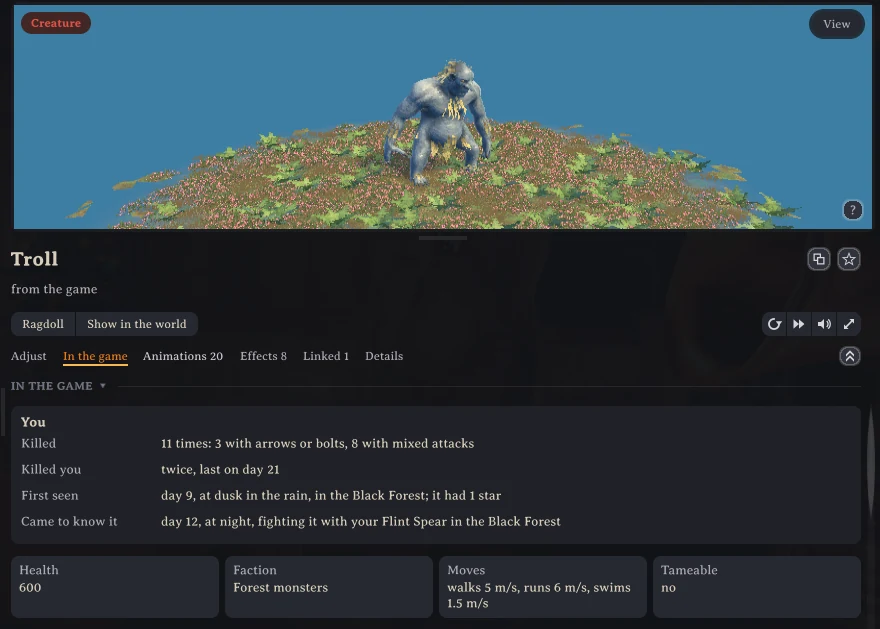
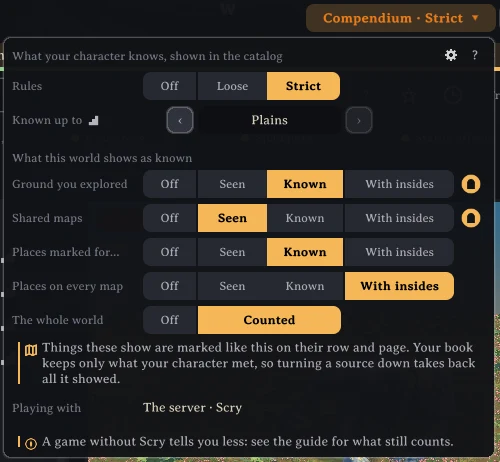
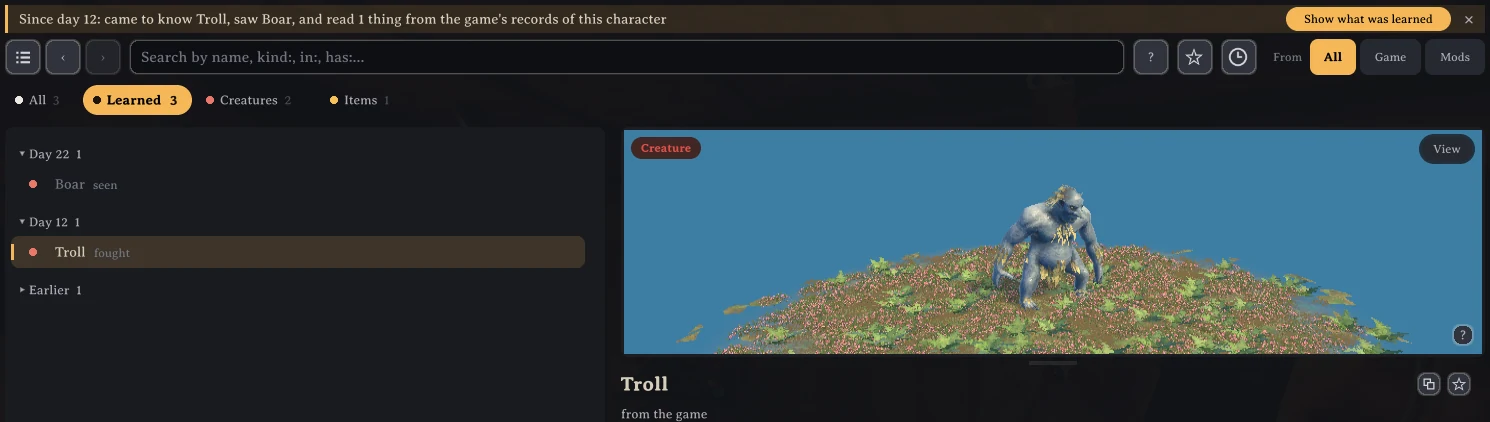
Turn it on for a character with Compendium at the top of the panel. A creature becomes known once fought or tamed, an item once held or made, a place once stepped into, a dungeon once entered; what was only seen stands on the stage with its page closed, telling how to come to know it. Loose shows a known page whole but names only what your character has met. Strict also keeps back how things connect until your character saw them go together, and the numbers the game never shows until it found them out, such as an attack's damage until it hit you. A page's You box tells when your character first saw the thing and came to know it, and how its fights went; Learned lists what it learned, day by day; Known up to opens every tier below the bosses it has beaten. A character played before is caught up from what the game keeps of it and from its explored map.
Exploring
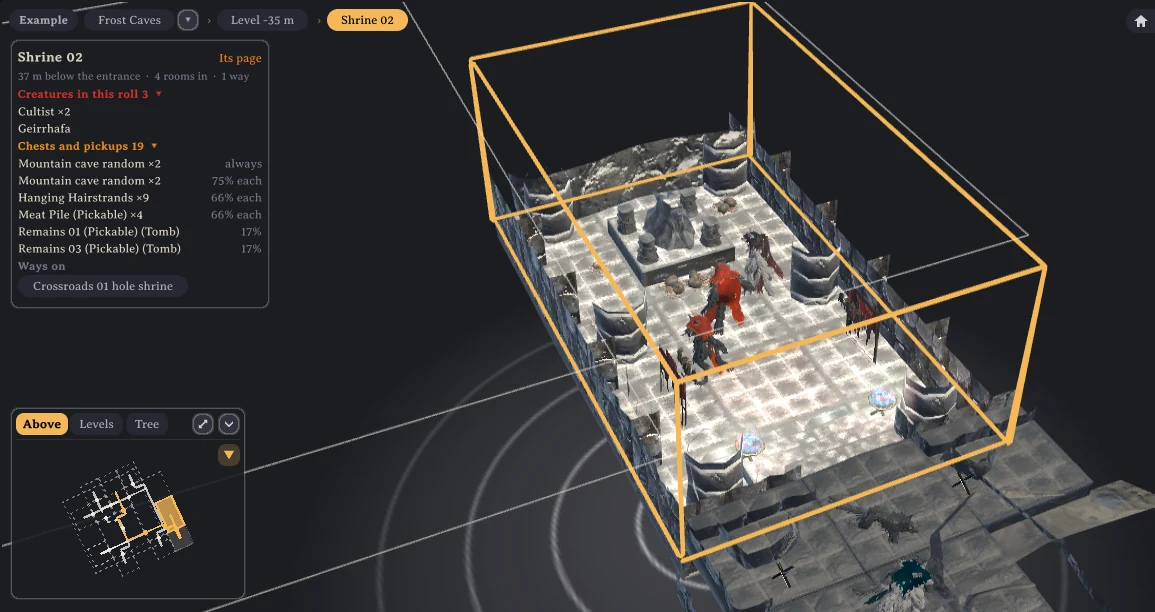
Dungeons you walk are kept as you walked them, room by room, and marked on Valheim's large map; a click on a mark shows the dungeon in Scry, its rooms on a plan you can go into. Each world can show more as known, source by source: the ground you explored, maps shared at a cartography table, places a Vegvisir or a rune stone marked, the places every map shows. Places tell where they lie in your ground and what they hold.
Playing together
Where your friends have Scry, what their game runs near you, a kill, a drop or a pick, counts for you as it would alone. With Scry on the server too, the compendium learns what only the server knows, such as how many of each place the world holds and which dungeons anyone on the server walked, and the server can set the compendium's rules for everyone.
Looking things up
Anything can also be looked at on the stage inside the panel: creatures at every star level, in any animation, with their gear and their attacks' sounds and effects; trees felled, pieces worn or broken, projectiles fired; locations and example dungeons as a new zone would roll them, cut open level by level. Every figure tells the game's rules behind it, what your skills make of it, which mods add or change it, and almost everything named can be clicked to go to it. The search takes terms such as kind:creature, biome:swamp and station:forge, and the ? beside it explains them all. With the compendium off, Scry is a lookup of everything the game and its mods hold.
Installing
Install from a mod manager. A server does not need Scry; with the same package in a dedicated server's plugins, or a player hosting the world, it does the server's part. How to set up a server, the compendium's rules in full and the server's settings are at https://github.com/isimp/Scry/blob/main/docs/guide/install.md
Settings
Settings are in BepInEx/config/isimp.Scry.cfg, each with a description; a server's are in its section 4 - World. Favourites and the panel's layout are kept in BepInEx/config/isimp.Scry, each character's knowledge in BepInEx/cache/isimp.Scry/compendium. Every /scry command is described at https://github.com/isimp/Scry/blob/main/docs/guide/commands.md
More, with technical notes and build instructions: https://github.com/isimp/Scry
CHANGELOG
Changelog
0.4.4
The kinds list on the map is one row per kind, in columns when made wider, and says what is picked and hidden when folded.
An eye hides a kind, a category or every mark, which stay kept; the title's pill shows them again. A mark's right-click menu can hide its kind too.
A click no longer removes a game pin hidden while a page shows its kind.
0.4.3
Kinds on the map now group by category, on the map's kinds list and the On the map list. Locations stand in circles and resources in triangles, each kind in a colour of its own. Marks you already have move to their category's shape once and keep their colour where it is free; a picture stays.
A click on a kind's mark picks its look: any colour and shape, one of the game's map pictures or the kind's own picture. Minimap dot size sizes the minimap's marks apart from the map's.
Marks that overlap show a pip each and spread out when you point at them. Far out, a kind's dots merge into one plain mark with how many. The settings' Map section chooses all this and how marks sit with the game's pins.
A click on a mark crosses that one spot off, as the game crosses its pins, a second highlights it, a third clears it. A right click opens a menu with those and its page. Crossed marks in the settings can hide those crossed.
The kinds list picks which kinds stand out, the rest faded, dungeon marks too. Drag it anywhere, fold it, size it. The On the map list scrolls, and a heading folds or takes off a whole category.
Ancient roots are listed under Tapped for sap, their pages telling their sap. Remains the game names alike are one row, as Petrified Bone. A page of several kinds can show or keep them all at once. A food the Serving Tray places tells so under Placing it.
A kill the game counts under a name several creatures share counts only for the ones you met, so the Ashlands no longer make their rogue known. Loot you watched fall from a death is met.
On a server running Kinsmen, a skill it counts lower than you keep it shows the level it counts there, as "58 here, 100 kept", and every figure at your level follows it.
0.4.2
A creature's attacks table now tells what each attack does to you at your armour and resistances, with stars, and how much harder your world makes creatures hit; an armour's Armour row tells what it does to a hit. A Dvergr mage's robes are its looks rather than kinds to switch to, and a creature that rolls one of several sets lists the attacks of the look shown. Creatures stand in the gear you saw them in, and a Dvergr's hair is no longer called a shield.
Scry's map marks hide with TargetPortal's pins and stay off ground you have not explored. A Gjall's taunt and egg drop are seen from as far as it uses them, and attacks that start alike are told apart on creatures a friend's game runs.
0.4.1
The compendium now learns things it used to miss: world pieces you hit, such as Dvergr crates and goblin fences; beds, chairs, ship helms, portals and ladders you use; loot a backpack mod stores outside your inventory; tall trees, landmarks and far-off creatures such as a Gjall; and attacks seen from as far as a creature uses them, taunts among them.
Attacks that start alike, or a projectile landing late, are now told by the attack that made them. A Dvergr mage and its fire, ice and support kinds, now named apart, wear the robes and hold the staffs you saw, as a Fuling shaman holds its staff, show the attacks seen of any of them and stand on Mistlands ground. A summon's line in an attacks table names what it summons. Fish stars are numbered 1 to 5 as in the game.
0.4.0
Show on map on a page marks where your character saw its kind, each kind in a colour and shape of its own. A place in ground you explored but never came near stands as the 128 m square it lies in, or as a hollow dot where the server sets Places in explored ground to Dots. Keep on the map keeps a kind there every time the map opens, on the minimap too, and the title row's On the map list holds what is kept and takes it off. Dungeons you walked or whose entrance you saw keep their amber marks, kept from the start in that list, which replaces the Dungeon marks switch and the pins on the compendium box's rows. Pointing at any mark says what it is.
The settings under the gear are one card in sections, each setting explained where it stands, with the compendium's rows and what the server allows under each. A new player is told the key once, and the first time Scry opens it offers a short setup. The compendium's guide reads at a glance, with examples. On a new install the keys keep walking your character while the panel is open; Search ready under On opening brings the old behaviour back.
The stage's sea holds what lives in it, flyers show in flight, and cloth, tails and hair move as they do in the world. Pages open at once and fill in over the next frames.
Under Strict every section says what to do about what it left out, as "Meet 55 more sources of Copper", and is:left finds the pages with more to find out; under Loose the title row reads like "3 of 6 met". Pages count only what you really do, each number the game never shows waits for what really shows it, and more is linked once you have seen it.
Smaller fixes throughout, among them the mouse's back button at times stepping back two pages, rules checked against the game again, and the Clear world button renamed Clear previews.
0.3.2
A place on the stage stands on the ground it digs for itself, so a tar pit sits in its bowl and a Burial Chambers' entrance in its stair pit.
Things that are one thing to a player are one row: the tar pits, the Burial Chambers, a creature and its kinds, an item and the copies creatures wear. The page switches among the kinds you met. A recipe the game holds several times over shows its cost once.
A fish's page tells where it lives and how deep the water must be, when it comes and bites, and how it fights by stars. The Creatures tab can group by biome or by taming, the Items tab by biome.
A person's animations follow what it holds and are grouped by what they are for, and a creature no longer lists attacks of its kin it cannot make. A death that hurts what stands near counts among its attacks. Clips are kept from one session to the next; /scry forget clips or Work out again works them out afresh.
A creature shows stars only where something in the world can give it some. Under Strict, a chain names each step once you saw it lead to the next, and a hen seen laying is paired with its egg. Hildir's Sealed Tower is marked as a place you were once you stand in it. Smaller fixes throughout.
0.3.1
The compendium follows what the game itself shows. A recipe's materials, a piece's cost or a store's wares come with the thing once the game lists them for your character, under Loose and Strict alike.
A creature is seen up close within 10 m, where the game names it and marks its stars, and is kept with the stars and gear it had. Under Strict the stage shows it only so, and an attack you saw begun up close counts as one taken.
What Strict keeps back shows as a soft smudge, a name not yet met as a dash. Each page's title row counts what is left to find out, and is:left finds the pages that still have some.
Drops show what you saw fall and how often, and what all your characters saw stands faint beside your own counts.
Learned lists what your character met and the numbers it found out, newest first, a day spent in another world named by it.
Playing together, what you learn depends on where you stand and what you did, not on whose game runs the thing. A death seen by its remains counts even where that game has no Scry, and a kill the game credits you with is yours.
The dungeon marks on the large map carry a glyph for the dungeon's kind and stand on its entrance. The settings size them, choose which show and put yours on the minimap.
The stage is filmed only while something on it changes, and the dungeon you walk no longer flickers on it while the panel is open. Smaller fixes throughout.
0.3.0
Scry keeps a compendium for each character, chosen at the top of the panel and offered once on a new character. Loose shows only what the character has met; Strict also keeps back how things connect, and the numbers the game never shows, until the character found them out. The ? in the compendium's box explains it in the game, and is:new, is:seen and is:walked search what the character met.
A page's You box tells when the character first saw a thing and came to know it, and how its fights went. Learned lists what it learned day by day, and Known up to opens every tier below the bosses it has beaten.
A character played before is caught up from what the game keeps of it and from its explored map.
Where friends have Scry, what their game runs near you counts for you as it would alone, and a notice names those whose games lack it.
Each world can show more as known, source by source in the compendium's box: explored ground, shared maps, marked places, places on every map. With Scry on the server, the compendium also learns what only the server knows, and the server can set its rules for everyone, which a notice tells once on joining. Explored ground shows its places through its own row, which can be turned off, as the map reaches 100 m around you whatever you saw, and a place counts as seen only once your eye has a clear line to it.
The gear in the title row holds the panel's settings, written to the config file as they are chosen, among them Stage set to Fast for big dungeons on weaker machines. The spin's speed and the lights below a dungeon's cut are in the View box, reading locations in every world is beside Find where things are, and the map's marks are in the compendium's box.
Dungeons are laid out room by room, with a plan to go into each room. The dungeon you are in shows as it was saved, your walks are kept and marked on the large map, and a server reads what was left inside dungeons walked before Scry.
Skills and traders have tabs of their own, and every figure a skill changes shows what it comes to at your level.
Pages tell more: weapon combos, a windmill's wind, what mods set or add to an item and its tooltip, stars' trophy chances as in Valheim 1.0.20, and readable names for all the game leaves unnamed.
What locations hold and where their floors are is kept between sessions, and big places are built and read over several frames.
A website opened from a mod's page no longer keeps Steam showing Valheim as running, the first step of a combo plays again, and the pointer comes back where it was after looking around.
0.2.0
Locations have a tab of their own: every location and dungeon room the world can place, grouped by biome, each telling where it is placed and what it holds. A location stands on the turntable as a new zone would roll it, its creatures included, and Roll again rolls it anew.
A dungeon or camp is built on the turntable as an example layout, with its floor plan in the corner, and a click on a room goes to it. Places can be cut open floor by floor with the ruler beside the stage, Page Up and Page Down, or Shift with the wheel; a place with nothing over its floors to take away, such as a ring of standing stones or a wreck, has no ruler and no cut. The rooms below a floor opened are dimmed and unlit; LightDimmedRooms keeps their lights.
Raids, biomes, spawners and mods have tabs of their own: what a raid brings and for whom, a biome's weathers, music and what lives there, a spawner's creatures and pace, and what each mod adds and which of the game's rules it hooks into.
In the game is laid out by topic, what a page is looked at for first, with tables where numbers change with something, such as a creature's attacks and stars or a weapon's damage by quality. An attack in a table plays when clicked.
Pages tell much more: a creature's senses, breeding, taming and riding, a piece's support, weather and placement rules, what gear resists and changes while worn, what burning, poison, frost and lightning do, fish and bait, keys and doors, and what follows a boss's fall. Pages of one kind show the same rows, saying none where that is the answer.
Loot is told by what it is worth: what nothing else gives is marked only here, what a trader buys is marked with its coins, then the rest, the least likely first. An item tells its odds in every chest, rock or tree that gives it.
A creature that comes only during a world event or after a boss's fall, such as Fimbulvinter's or the Charred, is listed apart from where it lives.
What a rock, vein or tree is broken with lists the pickaxes or axes that break it, the weakest first.
Each page names the mods hooking into what it tells, and what Scry is not sure of is marked with a ~ that says why. Drops seen in play are remembered from session to session.
The search takes more terms (is:, weak:, resists:, immune:, damage:, skill:, drops:, from:, needs:, gives: and spawns:), names in quotes, a comma for either of two values, and a name typed one letter off. Its help has an example of each.
The stage zooms toward the pointer and moves with a right-drag, and the Ground backdrop stands a model on its biome's own ground under its sky, its footsteps sounding on it. Volume, size, speed and Repeat sit beside the selection's name.
When part of Scry is off because the game changed, a strip under the header says what in plain words. Find in locations is called Read all locations. Numbers show their thousands with commas, and /scry monitor shows what Scry costs each frame.
0.1.0
First release.
